
From Rote Learning to Real Learning: The Shift Indian Schools Are Navigating
A System Built on Memory
There was a time when learning in India sounded like a chorus of repetition. Pages memorised. Definitions recited. Marks secured. And to be fair, it worked. Rote learning built discipline. It trained memory. It helped generations perform under pressure and succeed in competitive systems. So maybe the problem was never rote learning itself. Maybe the problem was when it became the only way to learn.
The Real Problem: When Learning Becomes Mechanical
Imagine a classroom.
A teacher asks, “Why does this formula work?”
A student answers perfectly.
But when asked to apply it in a slightly different context, they pause.
Not because they don’t remember. But because they don’t understand.
This is where blind rote learning begins to show its cracks.
It produces answers. But not always insight.
But Here’s the Irony
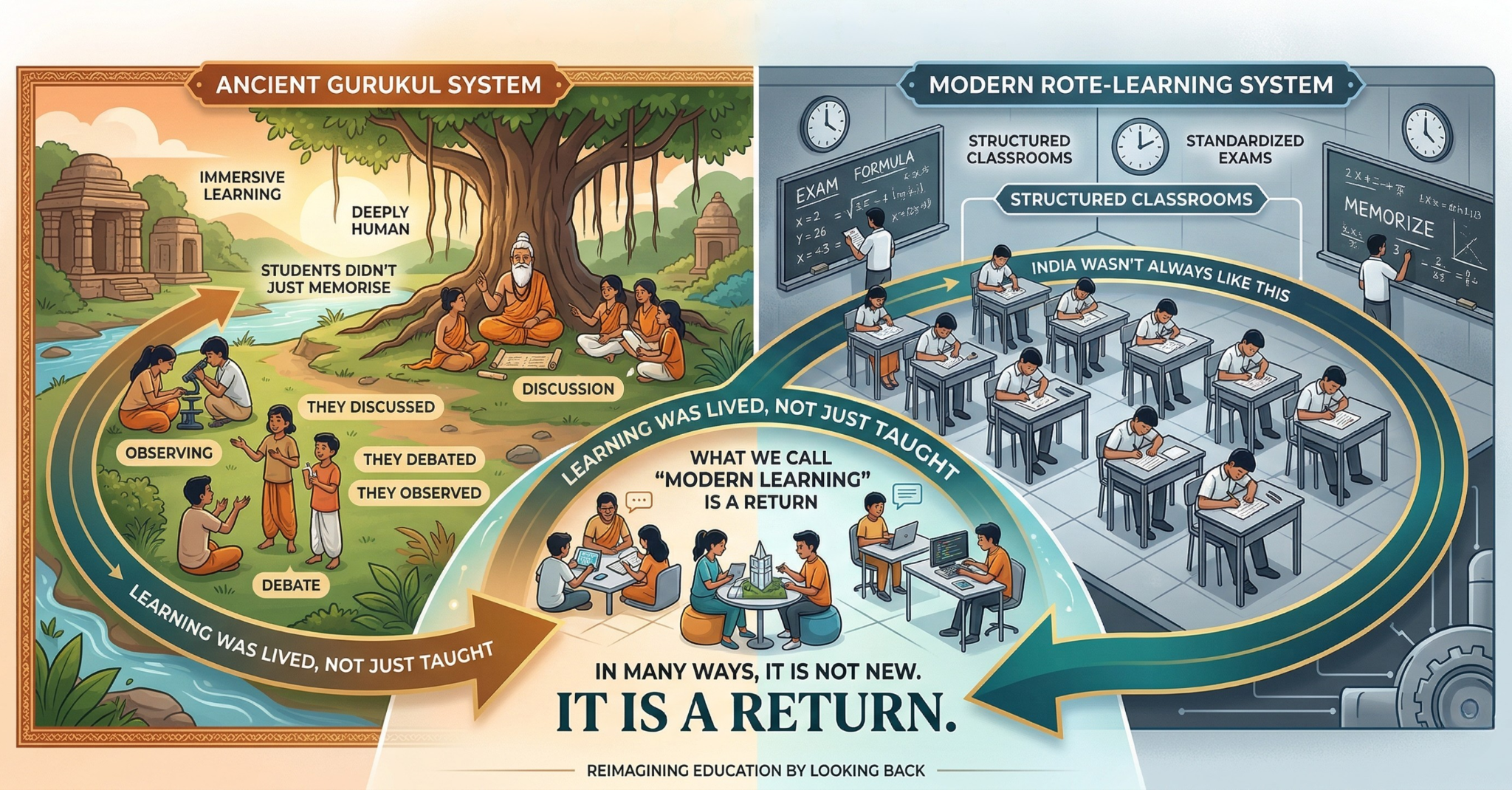
India wasn’t always a rote-learning system. Long before structured classrooms and standardised exams, learning in the ancient Gurukul system was immersive and deeply human. Students didn’t just memorise. They discussed. They debated. They observed. Learning was lived, not just taught. In many ways, what we now call “modern learning” is not new. It is a return.
The Changing Meaning of Learning
Today, knowledge is everywhere.
A student no longer needs to memorise information to access it.
But access alone is not enough.
What matters now is the ability to:
Identify what information is relevant
Understand the context behind it
Apply it meaningfully in different situations
This is where the role of education begins to shift.
From storing information… to processing it.
From finding answers… to asking better questions.
From delivering information…to developing thinking.
What This Shift Looks Like on the Ground
This is not just theory. It’s visible in classrooms that are evolving.
Picture this:
A group of students working on a simple science project.
One asks, “What if we try it differently?”
Another says, “That might fail.”
And the teacher responds,
“Good. Let’s find out.”
That moment - that permission to explore - is where real learning begins.
Where Schools Like AGFS Step In
At AAJ Global Foundation School, this shift is not treated as a trend. It is built into the
learning experience.
Instead of asking students to just solve problems, they are encouraged to frame them.
Instead of memorising concepts, they apply them.
For instance:
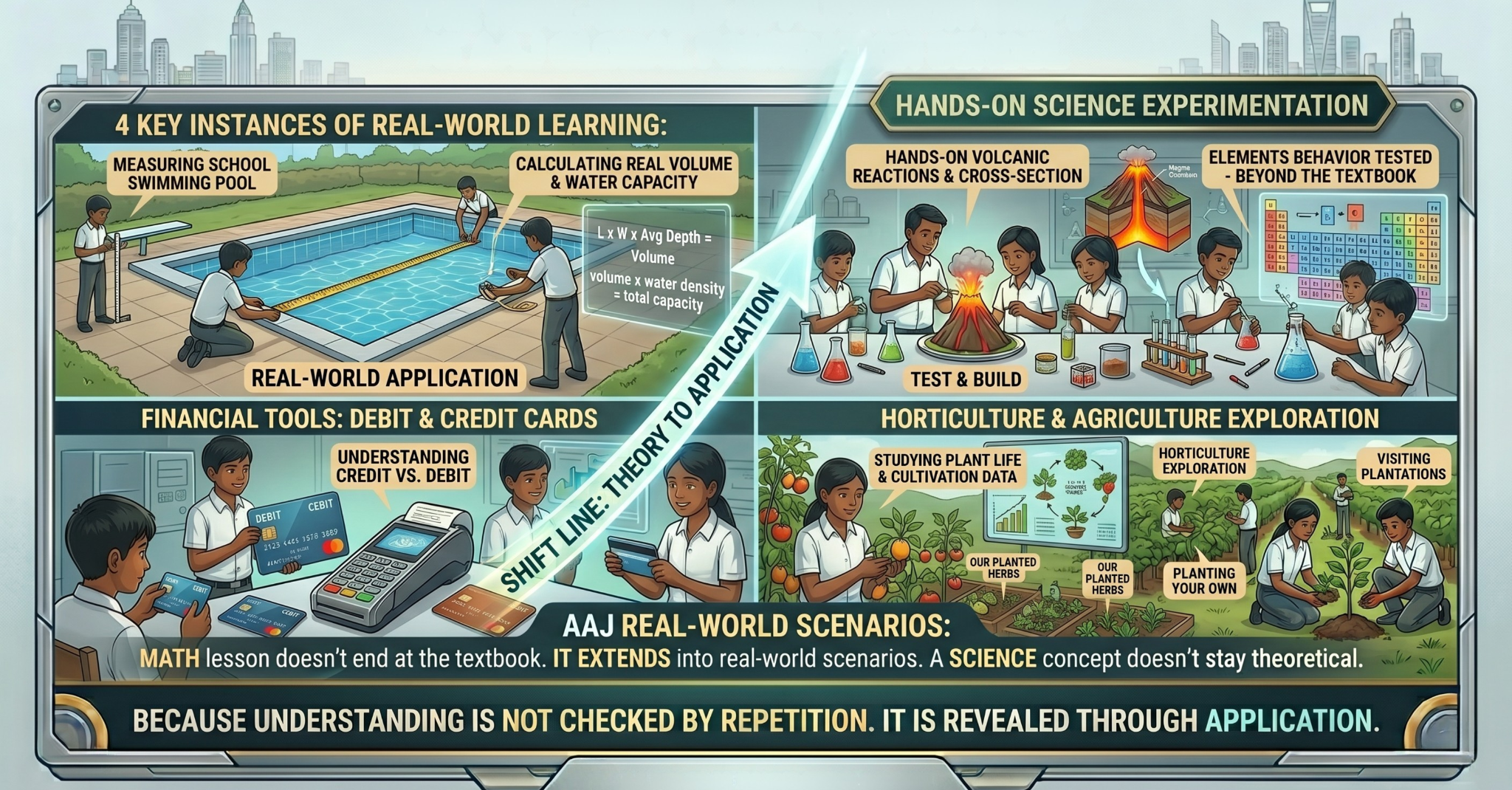
In mathematics, students measured the school swimming pool and calculated its
volume and water capacity - turning a formula into a real-world application.
In science, students conducted hands-on experiments like understanding volcanic reactions and how different elements behave.
In finance, students created and understood real-world tools like debit and credit cards.
In agriculture, students explored horticulture by visiting plantations, studying plant
life, and even planting their own.
A math lesson doesn’t end at the textbook.
It extends into real-world scenarios.
A science concept doesn’t stay theoretical.
It becomes something students test, build, and question.
Because understanding is not checked by repetition.
It is revealed through application.
The Parent Perspective We Don’t Talk About Enough
There’s also another layer to this shift.
Parents.
For years, marks were clarity.
A 95% meant certainty.
But as learning becomes more exploratory, that clarity begins to change.
Parents today are not just tracking scores.
They are learning to value curiosity, confidence, and independent thinking.
This shift also brings a growing awareness around mental well-being - for both students and
parents.
Less pressure to perform perfectly.
More space to learn, adapt, and grow.
And slowly, the definition of “doing well” is beginning to evolve.
Beyond Academics: The Real Outcome
The goal is not to eliminate rote learning.
Memory still matters. Practice still matters.
But they are no longer the destination.
They are tools.
The real outcome is a student who can:
● Think independently
● Adapt to new situations
● Solve problems they haven’t seen before
Because that’s what the real world demands.
The Shift Is Already Happening
Not everywhere. Not all at once.
But it’s happening.
In classrooms where questions are encouraged.
In schools where failure is part of the process.
In students who are learning how to think, not just what to write.
And in institutions like AGFS that are quietly redesigning what learning looks like.
A Sharper Truth to Leave You With
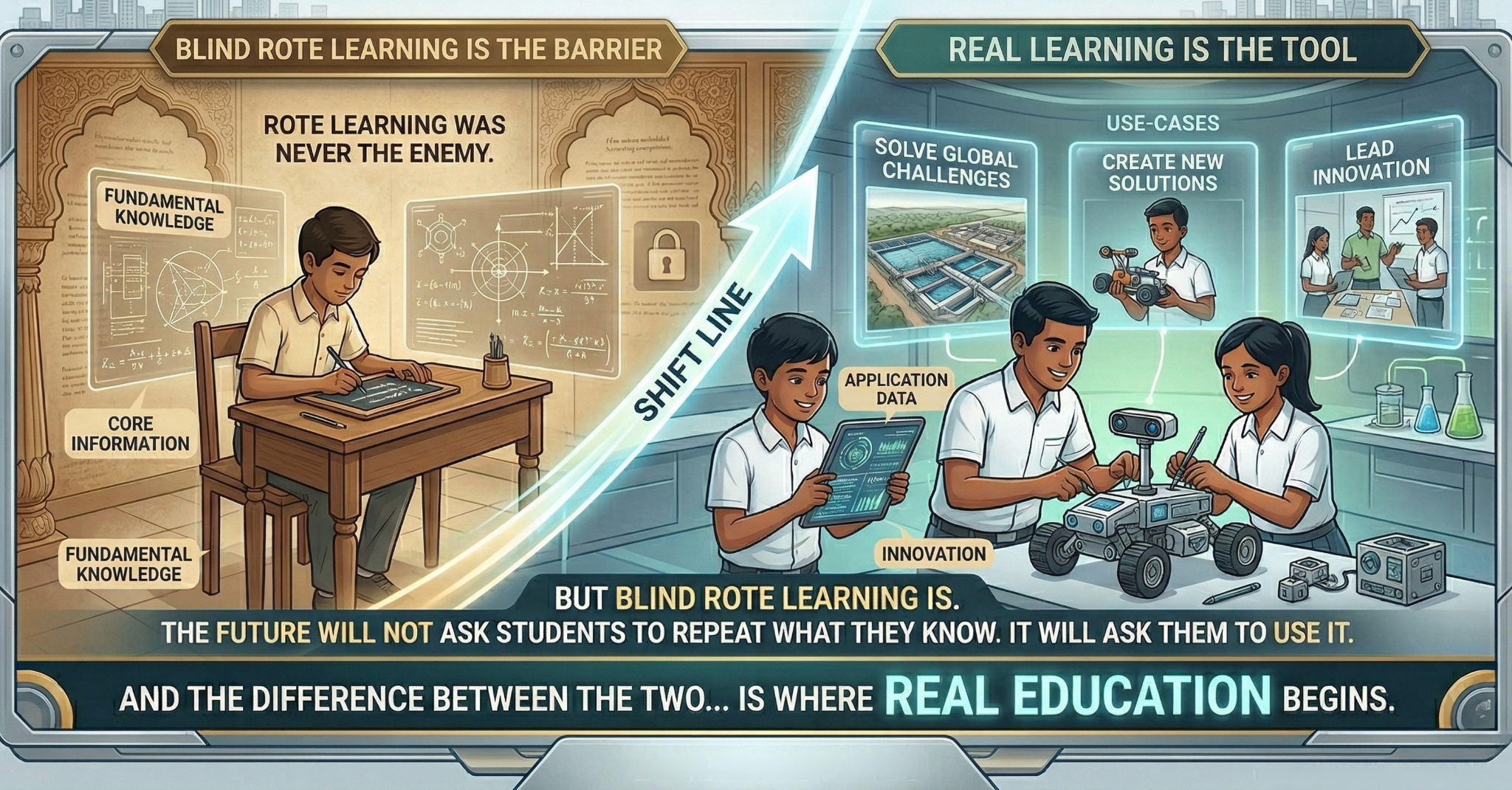
Rote learning was never the enemy.
But blind rote learning is.
Memory has always had its place. It builds discipline and creates a foundation. But when
learning stops at repetition, it limits what students can truly do with what they know.
The future will not ask our students to simply repeat what they know. It will ask them to apply
it, question it, connect it to the world around them, and use it with purpose.
And in that quiet but powerful shift… from memorising to meaning-making, is where real
learning begins.